

Beyond the Golden Ratio: Why Pour Over Ratios Are Changing
For years, the 1:18 coffee-to-water ratio felt like gospel for pour over coffee. It was the 'golden ratio,' the starting point for countless brewers. But the world of coffee is always evolving, and what worked perfectly well a decade ago is now being re-evaluated. We're seeing a shift towards slightly stronger ratios, and it’s not about dismissing tradition, but about chasing a more flavorful and concentrated cup.
Professional coffee tasters and baristas are increasingly leaning towards ratios in the 1:15 to 1:17 range. This isn't a random change; it’s driven by a desire to unlock more of the complex flavors hidden within specialty coffee beans. Modern coffee isn’t just about avoiding bitterness, it’s about maximizing the potential for sweetness, acidity, and nuanced aromatics.
The move towards stronger ratios reflects a broader trend in the specialty coffee world: a focus on extraction. We want to pull everything we can from those carefully sourced beans. A slightly higher coffee concentration helps achieve that, especially with the high-quality beans we’re seeing more readily available. It's about finding the balance between strength and clarity.
Don't worry, this doesn't mean the 1:18 ratio is wrong. It’s still a perfectly viable starting point, especially if you prefer a lighter, more delicate brew. But if you’re looking to elevate your pour over game and really experience the full potential of your coffee, understanding the shift towards these stronger ratios is a great place to begin.
Decoding the 1:16 Ratio: A Deep Dive
The 1:16 ratio has emerged as the most frequently recommended starting point by coffee professionals. But what does that actually mean? Simply put, it means using 1 gram of coffee for every 16 grams of water. So, if you're using 20 grams of coffee, you'll need 320 grams of water. A precise scale is essential for consistency here – eyeballing it just won’t cut it.
This ratio isn’t arbitrary. It’s a sweet spot that balances extraction, body, and flavor. It allows for sufficient contact time between the water and the coffee grounds without leading to over-extraction and bitterness. It encourages a fuller-bodied brew while still maintaining clarity and brightness. It's a really good place to start when experimenting with a new coffee.
The impact of a 1:16 ratio varies depending on the coffee bean itself. Lighter roasted beans, often from Ethiopia or Kenya, tend to benefit from this ratio, showcasing their floral and fruity notes. The ratio helps to avoid a thin, underdeveloped cup. Darker roasted beans, like Sumatran Mandheling, can also thrive at 1:16, providing a rich, chocolatey profile.
Washed process coffees often shine with this ratio, as their clean acidity is well-supported. Natural process coffees, known for their heavier body and fruit-forward flavors, might sometimes benefit from a slightly lower ratio (like 1:15) to prevent becoming overly sweet or muddy. It's all about understanding how the bean's characteristics interact with the brew. We’ve found that it’s a versatile starting point, even for blends.
Extraction is really what this ratio aims to maximize. Too little extraction leads to sourness, too much leads to bitterness. 1:16 aims for that "Goldilocks’ zone, where all the desirable flavors are pulled from the coffee without any harshness. It"s a balance that requires attention to detail, but the results are worth it.
Finding *Your* Ideal Ratio: It’s Not One-Size-Fits-All
Let’s be clear: the 1:16 ratio isn't a magic number. Taste is incredibly subjective. What one person considers perfect, another might find too strong or too weak. The 1:16 ratio is a fantastic starting point, a solid foundation for your pour over journey, but it’s up to you to fine-tune it to your preferences.
If you prefer a bolder, more intense coffee experience, try lowering the ratio to 1:15 or even 1:14. This will increase the coffee concentration and deliver a more robust flavor profile. Be mindful, though – going too low can lead to bitterness if your grind size isn’t adjusted accordingly. Conversely, if you prefer a cleaner, brighter brew, experiment with a higher ratio like 1:17 or 1:18.
Grind size plays a huge role here. A finer grind increases the surface area exposed to water, leading to faster extraction. If you’re using a finer grind, you’ll generally need a higher ratio (more water) to avoid over-extraction. A coarser grind, on the other hand, requires a lower ratio (less water) to ensure sufficient extraction. They’re intertwined.
Think of it like this: If you lower your ratio but keep your grind size the same, you’ll likely end up with a bitter cup. If you increase your ratio but keep your grind size the same, you’ll likely end up with a sour cup. Adjusting both in tandem is key. Don’t be afraid to experiment – keep a log of your brews and note the changes you make and the resulting flavors.
What's Your Pour Over Coffee Personality?
Finding the perfect pour over isn't just about technique, it's about tailoring the brew to *your* taste. This quick quiz will help pinpoint a starting coffee-to-water ratio that matches your flavour preferences. Remember, these are starting points – experimentation is key to unlocking your ideal cup!
The Role of Coffee Bean Density in Ratio Selection
Beyond personal preference, the density of your coffee beans significantly impacts the ideal ratio. Denser beans, like those often found in Sumatran coffees, require more energy (and therefore more water) to fully extract their flavors. These beans tend to be less porous, making it harder for water to penetrate and dissolve the solubles.
For denser beans, leaning towards a 1:17 or even a 1:18 ratio is often advisable. This provides the necessary contact time and water volume to achieve a complete and balanced extraction. Conversely, less dense beans, such as Ethiopian Yirgacheffe, are more porous and extract more easily.
Using a stronger ratio (like 1:15 or 1:16) with less dense beans can lead to over-extraction, resulting in a bitter or astringent cup. These beans release their flavors quickly, so you don’t need as much water to unlock their potential. It's about matching the extraction process to the bean’s structure.
Determining bean density isn’t always easy. Roasters often provide information about the bean’s characteristics, which can give you a clue. You can also observe the beans themselves – denser beans tend to feel heavier in your hand. Ultimately, experimentation is the best way to discover the optimal ratio for any given bean.
Practical Application: Recipes for Single Cup & Batch Brewing
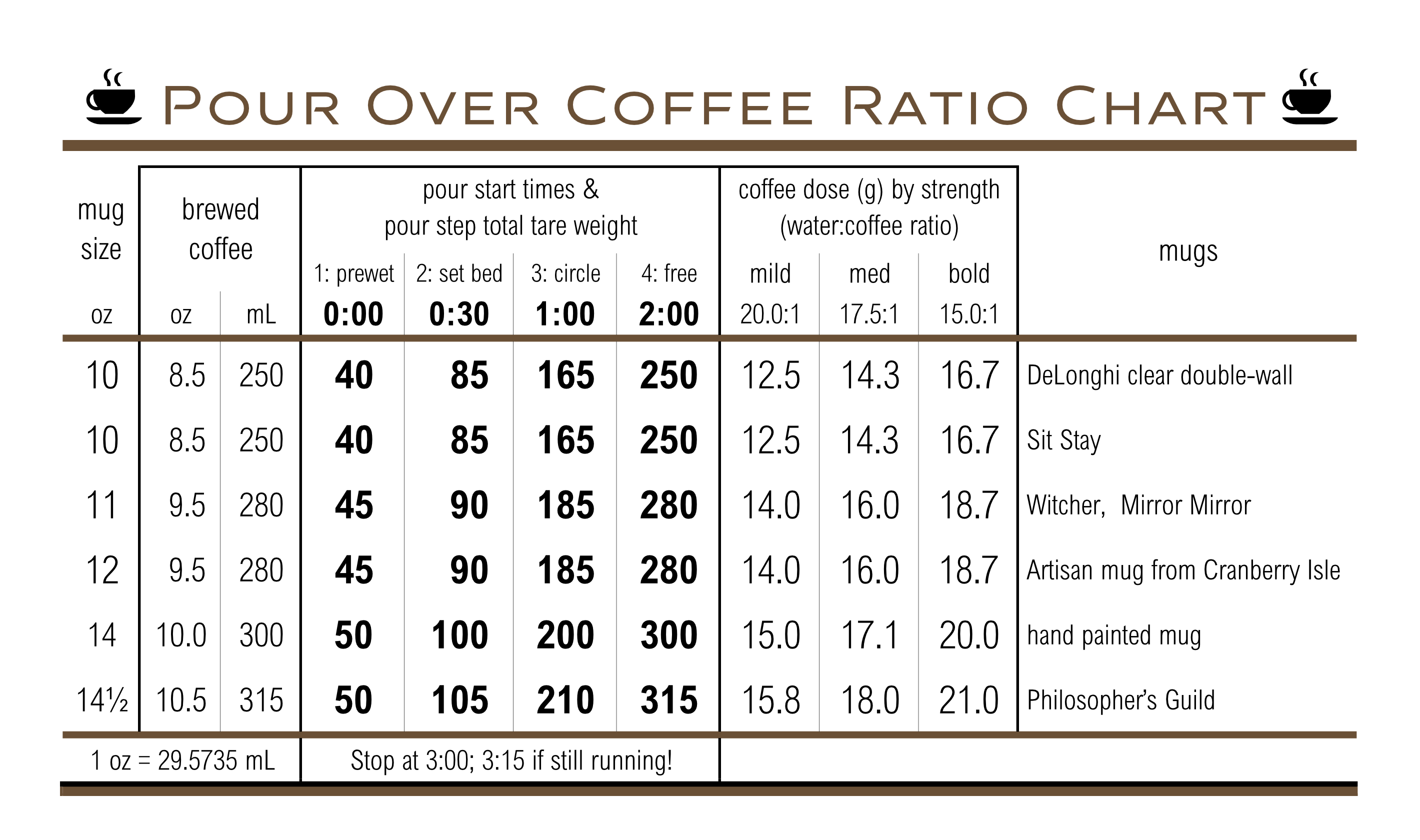
Let's put this into practice. Here are some specific measurements based on the 1:16 ratio. For an 8oz (240g) cup, you’ll need 15 grams of coffee. For a 12oz (360g) cup, use 22.5 grams of coffee. And for a 16oz (480g) cup, you’ll need 30 grams of coffee. Remember, accuracy is paramount, so invest in a good digital scale.
Scaling up to batch brewing, like for a Chemex or a larger pour over device, requires a bit more calculation. If you’re brewing 500g of coffee, you’ll need approximately 31.25 grams of coffee (500 / 16 = 31.25). Always round to the nearest tenth of a gram for precision.
Accurate measurement is crucial. A digital scale that measures in grams is non-negotiable. Avoid using measuring cups for water, as they are often inaccurate. For coffee, a scale is far more reliable than scoops. We recommend a scale with 0.1g precision for optimal results.
Here’s a handy table for quick reference:
Cup Size | Water (g) | Coffee (g) ------- | -------- | -------- 8oz (240g) | 240 | 15 12oz (360g) | 360 | 22.5 16oz (480g) | 480 | 30 Chemex 6-cup (720g) | 720 | 45 Chemex 8-cup (960g) | 960 | 60
- Cup Size: 8oz (240g), Water: 240g, Coffee: 15g
- Cup Size: 12oz (360g), Water: 360g, Coffee: 22.5g
- Cup Size: 16oz (480g), Water: 480g, Coffee: 30g
- Chemex 6-cup: (720g) Water: 720g, Coffee: 45g
- Chemex 8-cup: (960g) Water: 960g, Coffee: 60g
Pour Over Coffee Ratios (2024)
| Cup Size (oz) | Coffee (g) | Water (g) | Ratio |
|---|---|---|---|
| 8 | 15 | 240 | 1:16 |
| 12 | 22.5 | 360 | 1:16 |
| 16 | 30 | 480 | 1:16 |
| 20 | 37.5 | 600 | 1:16 |
| 24 | 45 | 720 | 1:16 |
| 32 | 60 | 960 | 1:16 |
| 40 | 75 | 1200 | 1:16 |
Data sourced from AI research — verify before making decisions
Troubleshooting: When Your Ratio Isn't Working
Even with the perfect ratio, things can go wrong. If your coffee tastes sour, it's likely under-extracted. This means the water didn’t dissolve enough of the desirable compounds. Try a lower ratio (more coffee) or a finer grind. Increasing the water temperature slightly can also help, but be careful not to exceed 205°F.
Conversely, if your coffee tastes bitter, it's probably over-extracted. The water dissolved too much of the undesirable compounds. Try a higher ratio (less coffee) or a coarser grind. Reducing the water temperature slightly can also mitigate bitterness. Remember that a long brew time can also contribute to over-extraction.
Grind size is often the culprit. If you’ve adjusted the ratio and still aren’t getting the results you want, focus on your grind. A too-fine grind can lead to over-extraction, while a too-coarse grind can lead to under-extraction. Experiment with small adjustments until you find the sweet spot.
Water temperature is also critical. Ideally, your water should be between 195-205°F (90-96°C). Too cool and you’ll under-extract; too hot and you’ll over-extract. Use a thermometer to ensure accuracy. Don’t just rely on bringing the water to a boil and letting it sit – the temperature will drop quickly.
Beyond Pour Over: Do These Ratios Apply to Other Methods?
The principles of coffee-to-water ratios apply to all brewing methods, but the ideal ratio will vary. French Press, with its full immersion brewing, generally benefits from a coarser grind and a lower ratio (around 1:15 to 1:17). Aeropress is incredibly versatile, but a good starting point is 1:15.
Drip coffee makers often have a fixed water-to-coffee ratio, but you can still influence the strength of your brew by adjusting the amount of coffee you use. If your drip coffee maker produces weak coffee, try using a slightly higher coffee-to-water ratio. The key is understanding the fundamentals and adapting them to your chosen method.
Ultimately, the ratio is a tool for controlling extraction. Regardless of how you brew, finding the right balance between coffee and water is essential for creating a delicious cup. Don't be afraid to experiment and find what works best for your equipment and your taste.
Experimentation Log: Track Your Perfect Brew
The best way to truly master pour over coffee is through consistent experimentation and careful observation. Keep a brewing log to track your results. Note the coffee bean origin, roast level, grind size, ratio, water temperature, brew time, and, most importantly, your tasting notes.
This log will become your personal coffee brewing bible. It will help you identify patterns and understand how different variables affect the final cup. You'll quickly learn which ratios work best for which beans and which adjustments yield the results you desire. It's a small effort that pays huge dividends.
No comments yet. Be the first to share your thoughts!