

Get your Chemex ready
Before you grind any beans, you need to prepare the vessel. This step might feel redundant, but it is the foundation of a clean brew. The Chemex uses thick, proprietary bonded paper filters that strip out oils and micro-fines, producing an exceptionally clean, bright, almost tea-like brew. Standard pour-over drippers use thinner paper filters that let more oils through, giving you a fuller body and richer mouthfeel. To get that signature Chemex clarity, you must start with the right filter.
Place the Chemex filter in the carafe with the three-layer side facing the pour spout. This creates a stronger seal and prevents the filter from collapsing under the weight of the water and grounds. The three layers should face the spout to ensure a tight fit against the glass.
Pour hot water through the filter and into the carafe. This removes the papery taste that can ruin your coffee’s flavor profile. It also preheats the thick borosilicate glass, which is essential because Chemex glassware is designed to be non-porous and clear, imparting no flavors or chemicals into your brewed coffee.
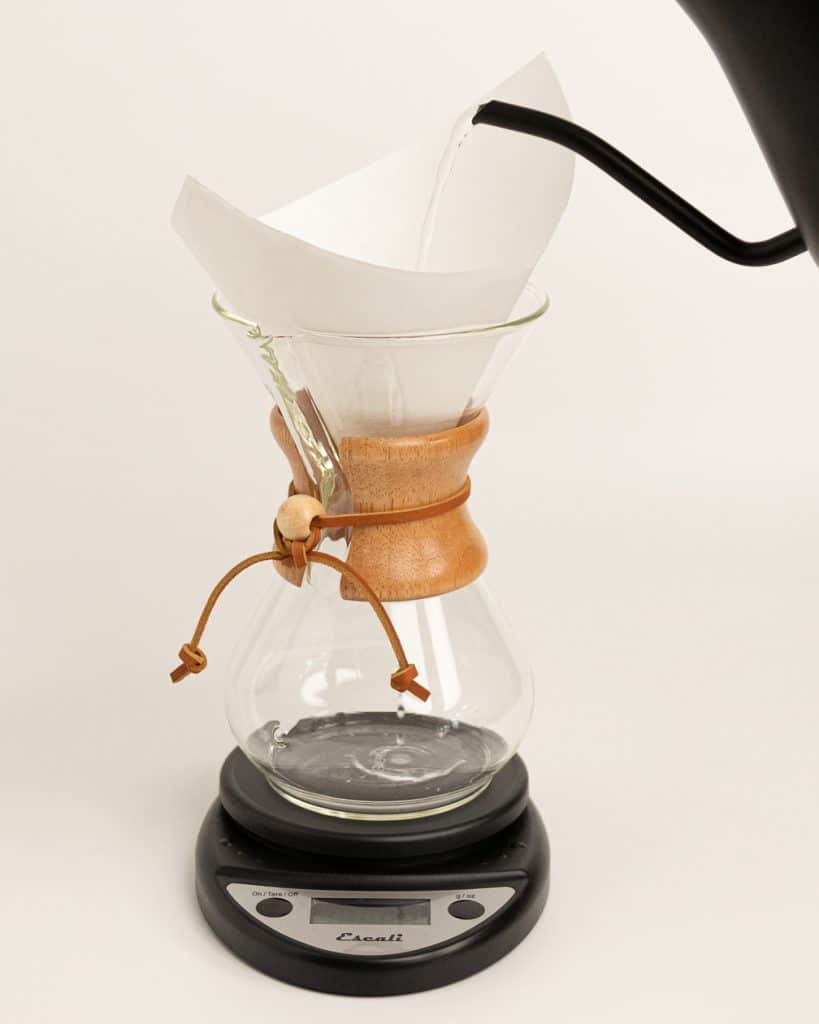
Empty the carafe completely. You want the vessel hot and the filter damp, but not waterlogged. A wet filter helps the grounds sit evenly, while a hot carafe maintains the brewing temperature during the pour. If the glass is cold, your coffee will cool too quickly, leading to under-extraction and a sour taste.
Measure coffee and water
The Chemex’s thick, bonded paper filters are its defining feature. They strip away oils and sediment, producing a clean, bright cup, but they also resist water flow. To compensate, you need a precise balance of coffee mass and water volume, along with a grind size that allows proper extraction without clogging the filter.
The 1:16 Ratio
A 1:16 coffee-to-water ratio is the standard starting point for Chemex brewing. This means for every gram of coffee, you use 16 grams of water. This proportion provides enough coffee solids to stand up to the filter’s absorption while maintaining clarity.
For a standard 3-cup Chemex (approx. 16 oz or 480 ml of water), you will need 30 grams of coffee. For a 6-cup Chemex (approx. 32 oz or 960 ml), use 60 grams of coffee. Starbucks recommends 45 grams for 24 fl oz (720 ml), which aligns closely with this 1:16 standard. Use a digital scale for accuracy; volume measurements with scoops are inconsistent due to grind density variations.
Grind Size: Medium-Coarse
Because the Chemex filter is thicker than those in standard drip machines or V60s, water moves through the bed more slowly. If the grind is too fine, the water will sit in the coffee bed, leading to over-extraction and bitterness. If it is too coarse, the water will rush through, resulting in a weak, under-extracted brew.
Aim for a medium-coarse grind. The texture should resemble sea salt or raw sugar. It should feel gritty but not powdery. This particle size creates enough surface area for extraction while leaving enough space between particles for water to flow freely through the thick filter paper.
Bloom the grounds first
Pour just enough hot water (around 200°F) over the coffee grounds to saturate them completely. You only need about twice the weight of the coffee in water—for a 340g Chemex batch, that’s roughly 680g total water, so start with 100–120g for this phase. The goal is to wet every particle without flooding the filter.
As the water hits the coffee, you’ll see the bed bubble and rise. This is the bloom: trapped carbon dioxide escaping from the freshly roasted beans. If you skip this step or rush it, the CO2 creates pockets of resistance in the filter. Water will then channel through the weakest spots, bypassing much of the coffee and leading to a sour, under-extracted cup.
Let the grounds sit for 30 to 45 seconds. You should see the bed swell and stay puffed up. This pause allows the gases to escape, opening up the coffee structure so the remaining water can extract flavors evenly. Think of it like pre-wetting a sponge; a dry sponge repels water, but a wet one absorbs it fully. Once the bubbling slows and the crust cracks slightly, you’re ready to proceed with the rest of your pour.
Pour in slow circles
The pour is the engine of the brew. Once the bloom has finished releasing carbon dioxide, begin pouring the remaining water in slow, concentric circles. Start at the center and spiral outward toward the filter wall, then spiral back in. This motion keeps the coffee bed agitated and ensures even extraction across all grounds.
A gooseneck kettle is essential here. The narrow spout gives you the precision needed to control flow rate and direction. Aim for a steady, medium stream. Pouring too fast causes channeling, where water finds the path of least resistance and bypasses much of the coffee. Pouring too slow can lead to over-extraction and a bitter, astringent taste.
Avoid pouring directly onto the paper filter. Water hitting the paper will bypass the coffee grounds entirely, diluting the brew and creating weak spots in the flavor profile. Instead, pour onto the bed of coffee itself. Keep the water level consistent, topping up as needed to maintain the target total brew time. This steady rhythm is what turns a messy experiment into a clean, bright cup.
Check your brew time
The total brew time for a Chemex is your primary feedback loop. For a standard 3–4 cup batch, aim for 4 to 5 minutes from the first pour to the final drip. This window allows the thick Chemex filter to properly extract the coffee without over-steeping the grounds.
If your brew finishes in under 4 minutes, the coffee will likely taste weak, sour, or watery. The water is moving through the grounds too quickly to extract enough flavor. To fix this, make your grind finer or pour more slowly to increase contact time.
Conversely, if the brew takes longer than 5 minutes, the coffee may taste bitter, dry, or astringent. The water is over-extracting the finer particles. Adjust by grinding coarser or increasing your pour speed to let gravity do its work faster.
A simple checklist for your brew day:
-
Scale
-
Timer
-
Gooseneck kettle
-
Chemex
-
Chemex filters
-
Burr grinder
-
Fresh beans
Common chemex: what to check next
You might wonder how the Chemex compares to other pour-over methods, why it tastes different, or if your gear is safe. Here are the answers to the most frequent questions about brewing with Chemex.
Why is Chemex different from Pour Over?
The Chemex uses a proprietary bonded paper filter that is significantly thicker than standard pour-over filters. This extra thickness strips out more coffee oils and micro-fines, resulting in an exceptionally clean, bright, and tea-like brew. Standard drippers use thinner paper that allows more oils through, giving you a fuller body and richer mouthfeel.
What's better, Chemex or V60?
The Hario V60 brews faster because its filter is thinner and allows water to flow more freely. To compensate, you typically use a coarser grind with the Chemex (around a 20 on standard scales) compared to the V60 (around 15). If you prefer a faster brew with more complexity, choose the V60. For a slower, cleaner cup, the Chemex is the better choice.
Do coffee machines release microplastics?
Many coffee makers, particularly those with plastic reservoirs or internal tubing, can release microplastics as hot water circulates through the machine. The Chemex avoids this issue entirely. It is made from high-quality borosilicate glass, the same material used in laboratory ware, which imparts no flavor or chemicals into your brewed coffee.
No comments yet. Be the first to share your thoughts!