
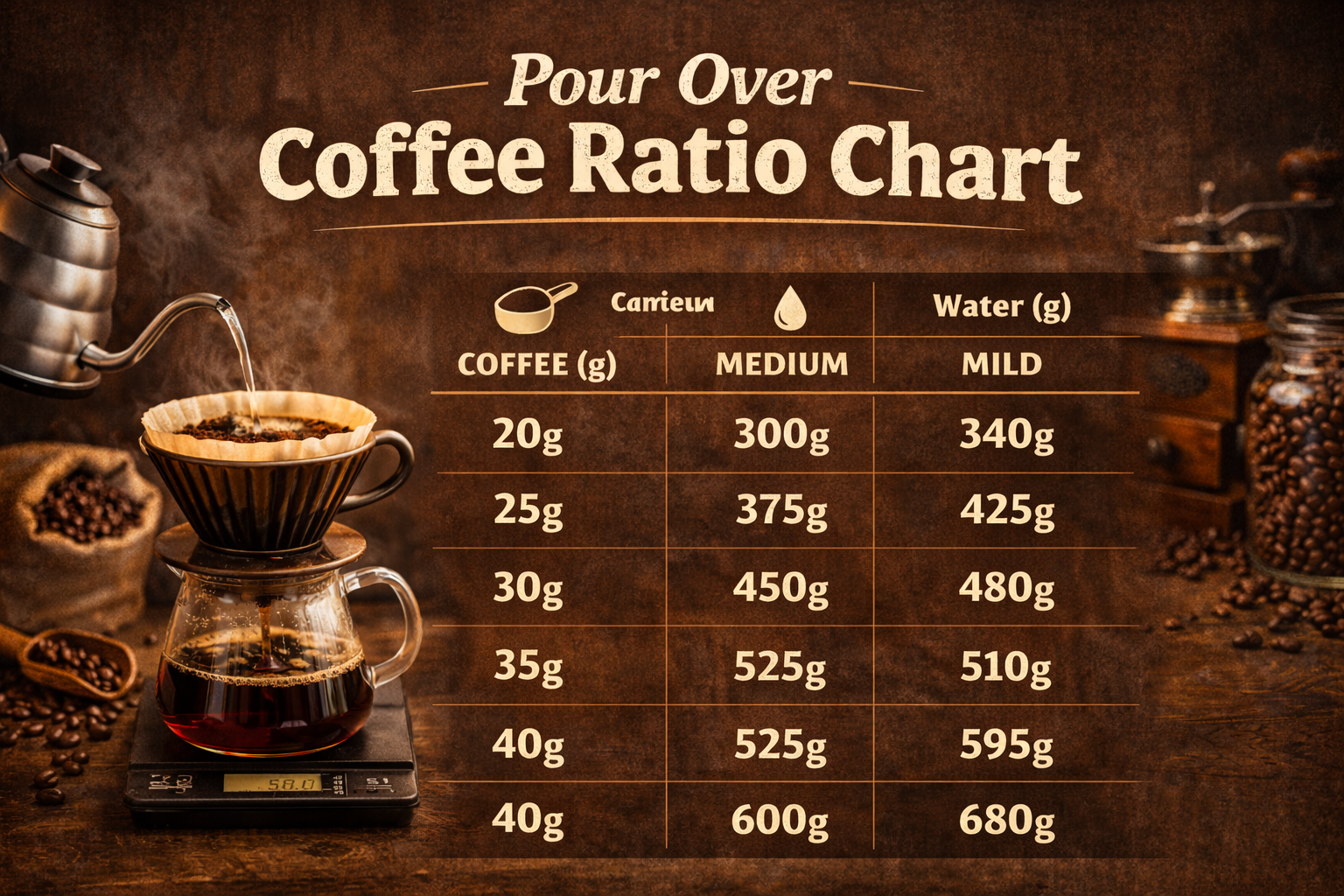

Understanding Coffee Ratios: The Foundation of Perfect Pour Over
The art of pour over coffee brewing begins with mastering one fundamental principle: the coffee-to-water ratio. This seemingly simple measurement is the cornerstone that determines whether your morning cup will be a perfectly balanced masterpiece or a disappointing brew that leaves you reaching for the sugar bowl.
Coffee ratios represent the mathematical relationship between the amount of coffee grounds and water used in brewing. Unlike other brewing methods where measurements can be somewhat forgiving, pour over coffee demands precision. The difference between a 1:15 and 1:17 ratio might seem minimal on paper, but it translates to dramatically different flavor profiles in your cup.
Why Coffee Ratios Matter More Than Ever in 2024
As specialty coffee culture continues to evolve, coffee enthusiasts are becoming increasingly sophisticated in their brewing techniques. The days of eyeballing coffee measurements are behind us. Modern pour over brewing requires understanding how ratios affect extraction, flavor balance, and overall coffee quality.
When you use too little coffee relative to water, you create an under-extracted brew that tastes weak, sour, and lacks body. Conversely, too much coffee creates an over-extracted, bitter cup that masks the nuanced flavors you paid premium prices to experience. The perfect ratio strikes a balance that allows the coffee's inherent characteristics to shine through.
Pour Over Coffee Ratio Comparison Guide
| Coffee Ratio | Strength Level | Flavor Profile | Recommended Use Case | Brewing Notes |
|---|---|---|---|---|
| 1:14 | Very Strong | Bold, intense, concentrated with pronounced acidity | Espresso-style pour over, dark roast beans, experienced coffee drinkers | Risk of over-extraction; requires precise timing |
| 1:15 | Strong | Rich, full-bodied with balanced acidity and sweetness | Morning brew, medium-dark roasts, cold weather drinking | Good for highlighting bean origin characteristics |
| 1:16 | Medium-Strong | Well-balanced, smooth with moderate body and clarity | Daily drinking, light to medium roasts, beginner-friendly | Industry standard; most forgiving ratio for technique errors |
| 1:17 | Medium | Clean, bright with subtle flavors and good clarity | Afternoon coffee, single-origin beans, filter exploration | Excellent for tasting notes evaluation |
| 1:18 | Light-Medium | Delicate, tea-like with enhanced sweetness and floral notes | Light roasts, specialty beans, multiple daily cups | Requires quality beans; weak with poor coffee |
The standard 1:16 ratio has emerged as the industry benchmark for good reason. This ratio—meaning 1 gram of coffee for every 16 grams of water—provides an excellent starting point for most coffee varieties and brewing equipment. However, understanding this baseline is just the beginning of your pour over journey.
The Science Behind Coffee Extraction
Coffee brewing is fundamentally about extraction—the process of dissolving soluble compounds from coffee grounds into water. These compounds include acids, sugars, oils, and aromatic molecules that create the complex flavor profile we associate with great coffee. The ratio you choose directly influences how much of these compounds end up in your final cup.
During the brewing process, water first extracts acids and bright flavors, followed by sugars and balanced flavors, and finally bitter compounds. The 1:16 ratio typically allows enough contact time and water volume to extract the desirable flavors while minimizing over-extraction of bitter elements.
Different coffee origins and roast levels respond uniquely to various ratios. Light roasts, with their denser cellular structure, often benefit from slightly stronger ratios like 1:15 to fully extract their complex flavor notes. Medium and dark roasts, being more porous and easier to extract, might perform better with ratios closer to 1:17.
Equipment Considerations for Ratio Success
Your choice of pour over equipment significantly impacts how ratios translate to flavor. A Chemex, with its thick paper filters, might require slight ratio adjustments compared to a V60 with its thinner filters. The filter type affects flow rate and contact time, which in turn influences extraction efficiency.

Water quality also plays a crucial role in ratio effectiveness. Hard water with high mineral content extracts coffee more efficiently than soft water, meaning you might need to adjust your ratios based on your local water characteristics. The ideal water temperature of 195-205°F ensures optimal extraction regardless of your chosen ratio.
Building Your Ratio Foundation
Before diving into advanced brewing techniques, establishing a solid understanding of basic ratios sets you up for consistent success. Start with the 1:16 ratio as your baseline, then make small adjustments based on taste preferences and coffee characteristics.
Remember that ratios work in conjunction with other brewing variables—grind size, water temperature, and pouring technique all influence your final cup. However, getting your ratio right provides the foundation upon which all other brewing decisions build.
Mastering Brewing Variables for Perfect Pour Over Coffee
While understanding the basic coffee-to-water ratio provides the foundation for great pour over coffee, achieving brewing excellence requires mastering several critical variables that work together to extract the perfect cup. These variables—water temperature, grind size, brewing time, and pouring technique—each play a crucial role in determining your final brew's flavor profile, strength, and overall quality.
Water Temperature: The Heat Behind Extraction
Water temperature stands as one of the most critical factors in pour over brewing, directly affecting extraction efficiency and flavor development. The optimal temperature range for pour over coffee falls between 195°F and 205°F (90°C to 96°C), with most coffee professionals recommending 200°F (93°C) as the sweet spot for balanced extraction.
Water that's too hot—above 205°F—will over-extract your coffee, leading to bitter, harsh flavors that overpower the bean's natural characteristics. Conversely, water below 195°F under-extracts the coffee, resulting in weak, sour, or underdeveloped flavors that fail to showcase the coffee's full potential. For light roasts, aim for the higher end of this range (200-205°F) to properly extract their delicate flavors, while medium to dark roasts perform better at slightly lower temperatures (195-200°F) to avoid excessive bitterness.
Grind Size: The Gateway to Flavor
Grind size directly controls extraction rate and brewing time, making it essential to match your grind to your brewing method. For pour over coffee, a medium-fine grind—similar in texture to sea salt or coarse sand—provides the ideal balance between extraction efficiency and brewing control. This grind size allows water to flow through the coffee bed at an appropriate rate while ensuring proper contact time for optimal flavor extraction.
Too fine a grind will slow water flow, leading to over-extraction and potential clogging of your filter. Too coarse a grind allows water to pass through too quickly, resulting in under-extraction and weak coffee. Consistency in grind size is equally important; uneven particles extract at different rates, creating an unbalanced cup with both over and under-extracted elements.
Interactive Brewing Calculator
Calculate your perfect pour over ratios and brewing parameters with our comprehensive brewing calculator. Input your desired coffee strength, cup size, and brewing method to receive customized recommendations for coffee weight, water volume, grind size, and brewing time.
Step-by-Step Brewing Process
Follow this detailed brewing guide to achieve consistent, exceptional pour over coffee every time. Each step has been optimized for the variables we've discussed, ensuring proper extraction and flavor development.
Brewing Variables Comparison Table
Understanding how different brewing variables affect your final cup helps you make informed adjustments to achieve your preferred flavor profile. This comprehensive table shows the relationship between key variables and their impact on extraction, strength, and flavor characteristics.
Timing and Pouring Technique
The timing and pattern of your water pours significantly influence extraction uniformity and flavor development. A typical pour over brewing process takes 3-4 minutes total, beginning with a 30-second bloom phase where you pour twice the weight of water as coffee (for 20g coffee, use 40g water). This bloom allows CO2 to escape and prepares the coffee bed for even extraction.
After blooming, continue with slow, circular pours, maintaining a steady water level and avoiding the filter walls. Pour in 2-3 additional stages, allowing the water level to drop between pours. This controlled pouring technique ensures even saturation and prevents channeling, where water finds easy paths through the coffee bed, leading to uneven extraction.
Visual Brewing Reference
This visual guide illustrates the proper pouring technique, grind size comparison, and brewing setup for optimal pour over coffee preparation.
Mastering these brewing variables requires practice and experimentation. Start with the recommended parameters and make small adjustments based on your taste preferences and the specific characteristics of your coffee beans. Remember that different origins, roast levels, and processing methods may require slight modifications to achieve optimal results.
Advanced Pour Over Techniques and Troubleshooting
Now that you understand the fundamentals of coffee ratios and brewing variables, it's time to refine your technique and troubleshoot common issues. The difference between good and exceptional pour over coffee lies in mastering these advanced principles and knowing how to adjust when things don't go according to plan.
The Science of Pour Over Timing and Technique
Perfect pour over coffee requires precise timing and pouring technique. The bloom phase, where you wet the coffee grounds with twice their weight in water, should last 30-45 seconds. This allows CO2 to escape and ensures even saturation. Following the bloom, pour in slow, circular motions from the center outward, maintaining a steady water level throughout the brewing process.
Your total brew time should fall between 4-6 minutes for optimal extraction. If your coffee brews too quickly, consider using a finer grind or pouring more slowly. Conversely, if brewing takes longer than 6 minutes, try a coarser grind or increase your pouring speed slightly.
Troubleshooting Common Pour Over Problems
Even experienced brewers encounter challenges. Sour or under-extracted coffee typically indicates insufficient extraction time, too coarse a grind, or water that's too cool. Bitter or over-extracted coffee suggests the opposite: too fine a grind, water that's too hot, or excessive brewing time.
Uneven extraction often results from inconsistent pouring technique or an uneven coffee bed. Ensure your grind is uniform and maintain steady, circular pours. If your coffee tastes weak despite using the correct ratio, check your grind size and water temperature—both may need adjustment.
Seasonal Adjustments and Bean Considerations
Your perfect coffee ratios may need seasonal adjustments. Humidity affects coffee beans' moisture content, potentially requiring slight ratio modifications. Darker roasts typically extract faster and may benefit from a coarser grind or slightly cooler water, while lighter roasts often need finer grinds and hotter water for optimal extraction.
Single-origin coffees showcase unique characteristics that may require ratio adjustments. Ethiopian beans might shine with a 1:17 ratio to highlight their floral notes, while Brazilian coffees could benefit from a 1:15 ratio to emphasize their chocolatey richness.
Building Your Pour Over Mastery
Consistency comes through practice and detailed record-keeping. Document your ratios, grind settings, water temperature, and tasting notes for each brew. This creates a personal reference guide that helps you replicate successful cups and avoid repeating mistakes.
Consider investing in quality equipment: a precise scale, gooseneck kettle, and consistent grinder make significant differences in your brewing results. Temperature-controlled kettles eliminate guesswork, while burr grinders ensure uniform particle size for even extraction.
The Future of Pour Over Coffee
As we move through 2024, pour over coffee continues evolving with new techniques and equipment. Smart brewing devices now offer precise temperature control and timing assistance, while advanced water filtration systems optimize mineral content for extraction. However, the fundamental principles of proper ratios and technique remain unchanged.
The key to pour over mastery lies in understanding these ratios as starting points rather than rigid rules. Every coffee origin, roast level, and personal preference creates opportunities for customization. Start with the 1:16 ratio, master the basic technique, then experiment with confidence to discover your perfect cup.
Remember that great pour over coffee is both science and art. While precise ratios and measurements provide the foundation, your palate and preferences guide the final adjustments. With practice, patience, and attention to detail, you'll consistently brew exceptional pour over coffee that showcases the unique characteristics of every bean you encounter.
No comments yet. Be the first to share your thoughts!