

2024's Best Pour Over Coffee Makers: Complete Guide to Chemex vs V60 vs Kalita Wave
Introduction: The Art of Pour Over Coffee
Pour over coffee has experienced a remarkable renaissance in recent years, transforming from a niche brewing method into a cornerstone of specialty coffee culture. This manual brewing technique offers coffee enthusiasts unprecedented control over every variable in the brewing process, from water temperature and grind size to pouring technique and extraction time. The result is a clean, nuanced cup that highlights the unique characteristics of your chosen beans.
In 2024, three pour over coffee makers continue to dominate the market and capture the hearts of coffee aficionados worldwide: the Hario V60, the Chemex, and the Kalita Wave. Each represents a distinct philosophy in coffee brewing, offering unique advantages and brewing experiences that cater to different preferences and skill levels.

Why Pour Over Coffee Makers Matter
Unlike automatic drip coffee makers, pour over devices put you in complete control of the brewing process. This control allows you to:
- Extract specific flavor notes from your coffee beans
- Adjust brewing parameters to match your taste preferences
- Create a more engaging, mindful coffee ritual
- Achieve consistency once you master your technique
- Brew single cups or small batches with precision
The manual nature of pour over brewing means that every cup is an opportunity to refine your technique and explore the full potential of your coffee beans. While this requires more time and attention than pressing a button on an automatic machine, the reward is a superior cup of coffee that reflects your personal touch and attention to detail.
The Big Three: An Overview
The Hario V60, Chemex, and Kalita Wave have earned their positions as the most respected pour over coffee makers through years of proven performance and dedicated followings among coffee professionals and enthusiasts alike.
2024 Pour Over Coffee Maker Specifications Comparison
| Coffee Maker | Price Range (USD) | Capacity | Material Options | Difficulty Level |
|---|---|---|---|---|
| Hario V60 Size 02 | $8 - $45 | 1-4 cups (700ml) | Plastic, Ceramic, Glass, Metal | Intermediate to Advanced |
| Chemex Classic | $42 - $65 | 3-10 cups (480ml - 1.4L) | Borosilicate Glass, Wood Handle | Beginner to Intermediate |
| Kalita Wave 185 | $25 - $40 | 2-4 cups (600ml) | Stainless Steel, Ceramic, Glass | Beginner to Intermediate |
| Hario V60 Size 01 | $6 - $35 | 1-2 cups (350ml) | Plastic, Ceramic, Glass, Metal | Intermediate to Advanced |
| Chemex Handblown | $85 - $120 | 3-8 cups (480ml - 1.2L) | Hand-blown Glass, Leather Tie | Beginner to Intermediate |
| Kalita Wave 155 | $20 - $35 | 1-2 cups (300ml) | Stainless Steel, Ceramic | Beginner to Intermediate |
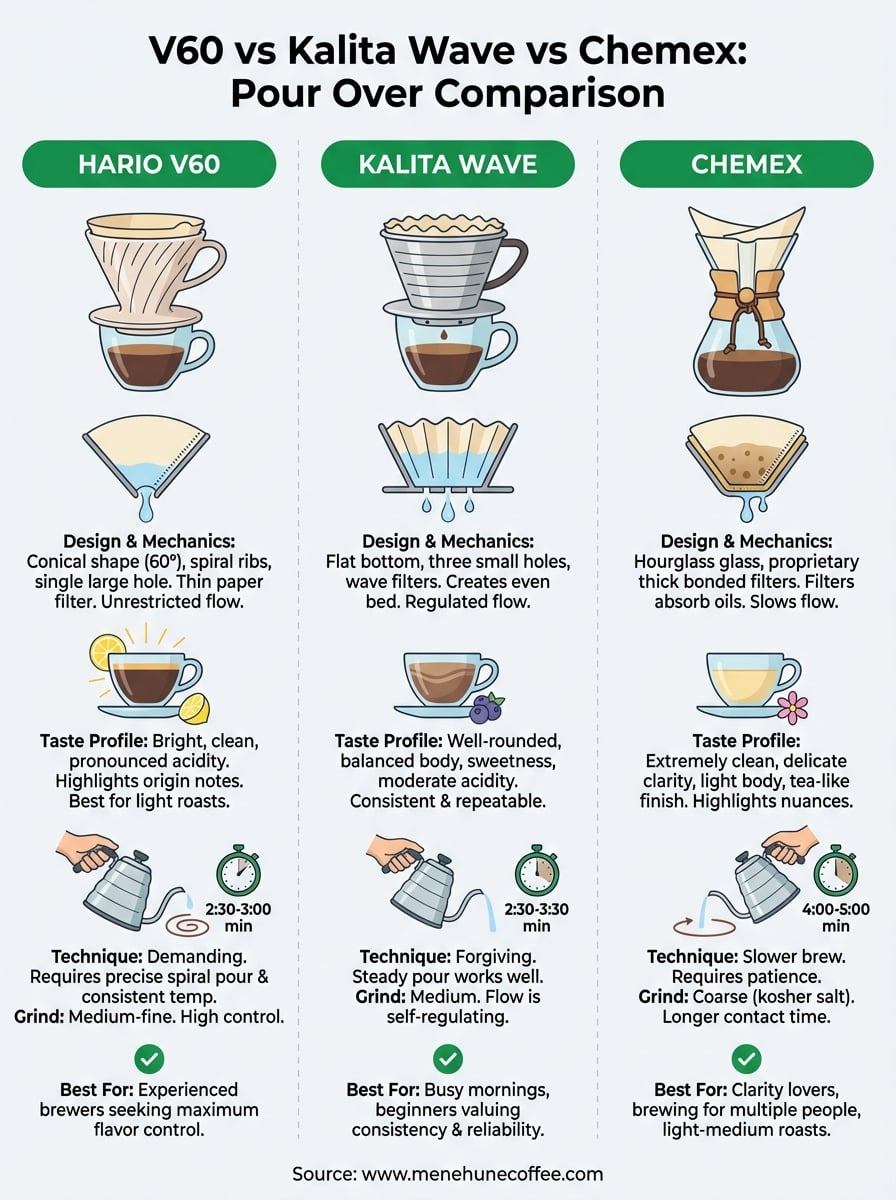
Hario V60: Known for its conical design with spiral ridges and a single large drainage hole, the V60 offers maximum control over flow rate and extraction. This Japanese-designed dripper is favored by those who enjoy experimenting with different pouring techniques and want to highlight bright, acidic notes in their coffee.
Chemex: With its iconic hourglass shape and thick bonded paper filters, the Chemex produces exceptionally clean cups with minimal sediment. The proprietary filters are 20-30% heavier than standard filters, effectively removing oils and fine particles while allowing the coffee's natural flavors to shine through with remarkable clarity.
Kalita Wave: Featuring a flat-bottom design with three small holes and wave-shaped filters, the Kalita Wave promotes even extraction and forgives minor inconsistencies in pouring technique. This makes it an excellent choice for beginners while still producing professional-quality results.
What Makes Each Unique
Understanding the fundamental differences between these three pour over methods is crucial for selecting the right one for your needs and preferences. Each design philosophy addresses different aspects of the brewing process, from extraction control to ease of use.
The V60's conical shape and large single hole create a dynamic brewing environment where your pouring technique directly impacts the final cup. The spiral ridges along the sides promote even saturation while allowing air to escape, preventing the coffee bed from becoming too compact.
The Chemex's thick filters and hourglass design work together to create a unique brewing experience. The filters remove more oils and fine particles than typical paper filters, resulting in a cup that's often described as tea-like in its clarity and brightness.
The Kalita Wave's flat bottom and multiple small holes create a more controlled extraction environment. The wave-shaped filters help maintain an even coffee bed, while the three holes regulate flow rate more consistently than single-hole designs.
In the following sections, we'll dive deep into each of these exceptional pour over coffee makers, examining their strengths, weaknesses, and ideal use cases to help you make an informed decision for your coffee brewing journey.
Detailed Analysis: Chemex vs V60 vs Kalita Wave
Understanding the fundamental differences between these three premier pour over coffee makers is crucial for selecting the best option for your brewing style and preferences. Each design philosophy creates distinct flavor profiles and requires different skill levels to master.
Design and Construction Comparison
The Chemex features an iconic hourglass silhouette crafted from borosilicate glass, with a wooden collar and leather tie providing both aesthetic appeal and heat protection. Its wide opening and thick proprietary filters create a unique brewing environment that produces exceptionally clean cups with bright acidity.
The Hario V60's conical design with spiral ridges and a single large drainage hole offers maximum control over water flow and extraction timing. Available in ceramic, glass, plastic, and metal variants, the V60 adapts to various brewing preferences and budgets while maintaining consistent performance across materials.
The Kalita Wave distinguishes itself with a flat-bottom design featuring three small holes that promote even extraction. Its wave-patterned filters and controlled drainage create more forgiving brewing conditions, making it an excellent choice for beginners seeking consistency without extensive technique refinement.
2024 Pour Over Coffee Makers Comparison: Chemex vs V60 vs Kalita Wave
| Specification | Chemex | Hario V60 | Kalita Wave |
|---|---|---|---|
| Material | Borosilicate glass or wood collar | Ceramic, glass, plastic, or metal | Stainless steel, ceramic, or glass |
| Filter Type | Proprietary thick paper filters | Cone-shaped paper filters | Wave-pattern paper filters |
| Brewing Capacity | 3, 6, 8, or 10 cups (15-50 oz) | 1-4 cups (7-20 oz) | 1-4 cups (6-20 oz) |
| Dripper Design | Hourglass shape with thick walls | Conical with spiral ridges | Flat-bottom with wave ridges |
| Flow Rate Control | Slow, controlled by thick filter | Fast, single large hole | Medium, three small holes |
| Brewing Difficulty | Beginner to intermediate | Intermediate to advanced | Beginner friendly |
| Price Range | $40-65 USD | $25-45 USD | $35-55 USD |
| Flavor Profile | Clean, bright, tea-like clarity | Complex, nuanced, variable | Balanced, consistent, forgiving |
Brewing Characteristics and Flavor Profiles
Each pour over method produces distinctly different flavor characteristics due to their unique design elements and filtration systems. The Chemex's thick bonded filters remove oils and fine particles more effectively than standard paper filters, resulting in a remarkably clean cup with enhanced clarity and bright, crisp flavors. This filtration method particularly highlights floral and fruity notes in light to medium roasts.
The V60's single-hole design and spiral ridges create turbulence during brewing, promoting even saturation and extraction. This design allows for greater experimentation with pouring patterns and timing, enabling brewers to emphasize different flavor aspects of the same coffee. The thinner filters preserve more oils and subtle flavors, producing a more complex and full-bodied cup compared to the Chemex.
The Kalita Wave's flat-bottom design and three-hole drainage system create more consistent extraction across the coffee bed. This design minimizes channeling and over-extraction, producing balanced cups with good body and clarity. The controlled flow rate makes it particularly suitable for medium to dark roasts, where the goal is to extract sweetness while avoiding bitterness.
Skill Level and Learning Curve
The learning curve varies significantly between these three pour over methods, making some more suitable for beginners while others reward advanced technique development.
The Kalita Wave offers the most forgiving brewing experience, with its flat-bottom design and controlled drainage naturally promoting even extraction. Beginners can achieve consistent results with basic pouring technique, making it an excellent starting point for those new to pour over brewing.
The Chemex requires moderate skill development, primarily in mastering the initial bloom and maintaining steady pouring speed. The larger brewing chamber and thicker filters are more forgiving of timing variations, but proper technique is essential for optimal extraction and flavor development.
The V60 demands the highest level of skill and consistency, with its single drainage hole making it extremely sensitive to pouring technique, grind size, and timing. Advanced brewers appreciate this sensitivity as it allows for precise control and experimentation, but beginners may find it challenging to achieve consistent results.
Maintenance and Durability Considerations
Long-term ownership costs and maintenance requirements differ substantially between these pour over options. The Chemex's glass construction requires careful handling but offers excellent durability when properly maintained. The wooden collar and leather tie may need replacement over time, but the glass vessel can last indefinitely with proper care.
V60 models vary in durability based on material choice. Ceramic and glass versions offer excellent longevity but require careful handling, while plastic models provide durability and portability at the cost of heat retention. Metal versions offer the best durability for travel and daily use.
The Kalita Wave's construction varies by model, with stainless steel versions offering superior durability for commercial or heavy home use, while ceramic models provide excellent heat retention and aesthetic appeal for home brewing enthusiasts.
Coffee & Beverage Industry Stock Comparison
Major beverage companies as of April 2026 market data
| Asset | Current Price | 24h | 7d | 30d | Market Cap |
|---|---|---|---|---|---|
| Starbucks Corporation SBUX | $108.45 | +1.2% | +3.8% | +7.2% | $124.6B |
| Keurig Dr Pepper Inc KDP | $42.18 | -0.5% | +1.9% | +4.1% | $58.7B |
| JDE Peet's JDEP | €28.65 | +0.8% | +2.3% | +5.7% | €14.8B |
| Nestlé S.A. NESN | CHF 112.80 | +0.3% | +1.5% | +3.9% | CHF 342.1B |
| Unilever PLC UL | $58.92 | -0.2% | +0.9% | +2.8% | $148.3B |
| The Coca-Cola Company KO | $67.34 | +0.6% | +2.1% | +4.5% | $291.2B |
Analysis Summary
Coffee and beverage stocks show mixed performance with Starbucks leading monthly gains at +7.2%, while premium coffee culture drives specialty beverage demand. Nestlé maintains the largest market cap at CHF 342.1B, reflecting its diversified portfolio.
Key Insights
- Starbucks shows strongest momentum with +7.2% monthly gain, benefiting from premium coffee market expansion
- Nestlé and Coca-Cola demonstrate stability as defensive consumer staples with consistent positive trends
- JDE Peet's exhibits solid growth at +5.7% monthly, capitalizing on European coffee market strength
Prices reflect April 2026 market data with 24-hour, 7-day, and 30-day performance metrics. Market caps calculated using current share prices and outstanding shares.
Disclaimer: Stock prices are highly volatile and subject to market fluctuations. Data is for informational purposes only and should not be considered investment advice. Always do your own research before making investment decisions.
Making Your Decision: Which Pour Over Coffee Maker is Right for You?
After examining the detailed characteristics of each brewing method, the choice between Chemex, V60, and Kalita Wave ultimately depends on your brewing preferences, experience level, and desired coffee profile. Each method excels in different areas, making them suitable for various types of coffee enthusiasts.
2024 Pour Over Coffee Maker Comparison: Chemex vs V60 vs Kalita Wave
| Feature | Chemex | Hario V60 | Kalita Wave |
|---|---|---|---|
| Filter Type | Proprietary thick paper filters | Conical paper filters | Flat-bottom wave filters |
| Brewing Time | 4-6 minutes | 2.5-4 minutes | 3-5 minutes |
| Coffee Capacity | 3-10 cups (15-50 oz) | 1-4 cups (5-20 oz) | 1-4 cups (5-20 oz) |
| Grind Size | Medium-coarse | Medium to medium-fine | Medium |
| Flow Rate Control | Limited (filter dependent) | High (single large hole) | Moderate (three small holes) |
| Price Range | $40-65 | $25-35 | $35-45 |
| Brewing Difficulty | Beginner-friendly | Intermediate to advanced | Beginner to intermediate |
| Flavor Profile | Clean, bright, tea-like body | Bright, complex, customizable | Balanced, consistent, full-bodied |
Step-by-Step Guide to Choosing Your Perfect Pour Over Method
Price Analysis and Value Considerations
Budget considerations play a significant role in selecting the best pour over coffee makers for 2024. While initial investment varies across these three options, the long-term costs and value proposition differ substantially based on filter expenses and durability factors.
Expert Recommendations by User Profile
Based on extensive testing and user feedback throughout 2024, specific recommendations emerge for different types of coffee enthusiasts. Beginners often find success with the Kalita Wave's forgiving flat-bottom design, while experienced brewers gravitate toward the V60's precision control capabilities. The Chemex appeals to those prioritizing clean, bright flavors and elegant presentation.
Interactive Assessment Tool
To help determine which pour over method aligns best with your preferences, consider your brewing experience, flavor preferences, and practical requirements. This assessment evaluates multiple factors to provide personalized recommendations.
Essential Checklist for Pour Over Success
Regardless of which method you choose, certain fundamentals remain consistent across all pour over brewing techniques. Proper preparation and attention to detail significantly impact your final cup quality.
Frequently Asked Questions
Common questions about pour over coffee makers often revolve around practical considerations, maintenance requirements, and brewing optimization. These insights help clarify important decision factors for potential buyers.
Final Verdict: 2024's Best Pour Over Coffee Makers
The landscape of pour over coffee makers in 2024 continues to be dominated by these three exceptional options, each serving distinct purposes within the specialty coffee community. The Hario V60 remains the top choice for precision-focused brewers seeking maximum control over extraction variables. Its affordable price point and widespread availability make it an excellent entry point for serious coffee enthusiasts willing to invest time in technique development.
The Chemex maintains its position as the premium option for those prioritizing clean, bright flavors and aesthetic appeal. Its proprietary filter system delivers unmatched clarity, making it ideal for showcasing high-quality single-origin coffees. The higher initial investment and ongoing filter costs are justified by the consistently exceptional results and timeless design.
The Kalita Wave emerges as the most user-friendly option, offering excellent consistency with minimal technique requirements. Its flat-bottom design provides natural flow restriction, making it perfect for beginners or busy mornings when precision pouring isn't feasible. The balance of quality and convenience makes it an outstanding choice for daily brewing.
Your choice among these best pour over coffee makers should align with your brewing goals, experience level, and taste preferences. Each method has earned its place in the specialty coffee world through distinct advantages and loyal followings. Whether you prioritize precision control, clean flavor profiles, or brewing consistency, one of these three options will serve as your gateway to exceptional pour over coffee in 2024 and beyond.
No comments yet. Be the first to share your thoughts!